Following the Footsteps of a Saint: A 12-Day Pilgrimage from Poland to Rome
- Luz Kyncl
- 0 comments
It’s hard to put into words twelve days of transformation.
This wasn’t a sightseeing trip. It was a soul walk, a journey through Poland and Rome, tracing the footsteps of Saint John Paul II and the echoes of faith that refuse to die.
Before leaving, I couldn’t quite explain what I was searching for. I just knew I needed to remember what still felt holy in a world that moves too fast, talks too loud, and forgets too easily. Maybe, deep down, I came to remember that Jesus is still coming soon, not in thunder or warning, but in the small, steady ways He shows up when we slow down enough to notice.
From the cobblestone streets of Kraków to the silence of Auschwitz, from the mountain chapels in Zakopane to the dome of St. Peter’s in Rome, I began to understand that the Second Coming isn’t only a someday event; it’s a daily arrival. Every time we choose faith over fear, presence over panic, forgiveness over noise, He comes again.
“Do not be afraid,” John Paul II once said.
And yet, like most of us, I have been afraid of letting go, of slowing down, of hearing what silence might say.
But something happens when you walk the same roads a saint once walked. The noise inside you begins to quiet. The sacred feels closer. The heart, softer.
This pilgrimage began in Poland, ended in Rome, and somehow led me back to the same truth I wrote about months ago, the one I still need to keep learning: that calm is sacred, that love wins quietly, and that yes, Jesus is still coming soon, every time a weary heart dares to believe again.
🇵🇱 The Polish Beginning: Where Faith Was Born and Tested
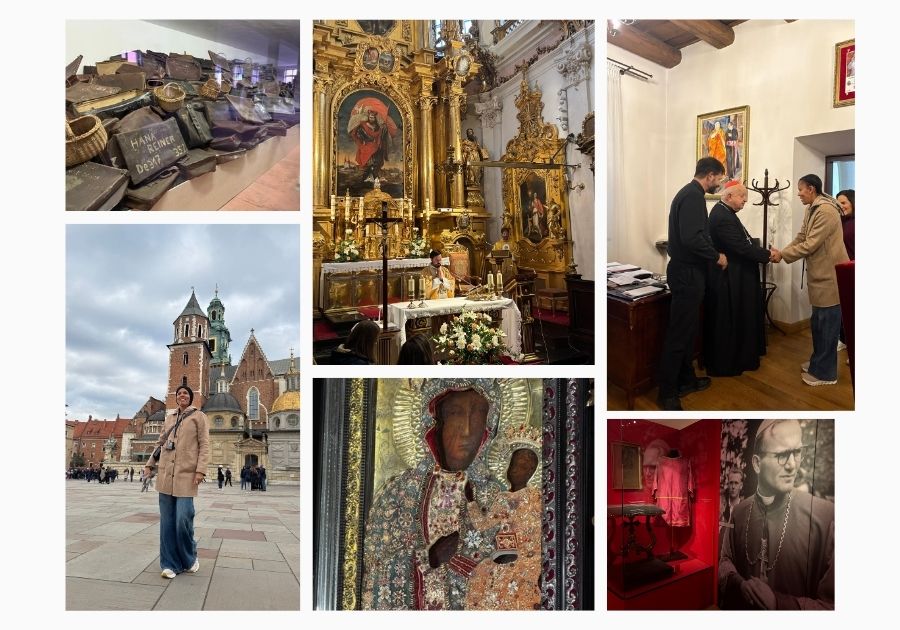
Kraków was where it all began. Morning bells rang through the old city as we walked toward the Cathedral. Faith here wasn’t an idea; it was stone, memory, and song.
We celebrated our first Mass at the Sanctuary of Saint John Paul II, standing before the relic of a man who lived through war, loss, and the weight of leadership, and somehow still chose hope. Meeting Cardinal Stanisław Dziwisz, who served beside him for decades, felt like touching history itself. His eyes carried reverence and weariness, as if faith, too, has its own gravity. I thought of a passage from my book, the section on Jesus Is Coming Soon, where I wrote:
“Faith is not about feeling strong; it’s about remembering who holds you when you are not.”
That line echoed differently in Kraków. I thought of how often we look for proof of God in comfort or clarity, when sometimes His presence is most alive in endurance, in those who keep showing up for Mass after burying their children, who keep believing after silence, who keep loving in a world that keeps wounding.
We also visited Auschwitz, where silence became its own sermon. We walked past rows of shoes, hair, and suitcases that once held whole lives. There were no eloquent words, only a trembling reverence. Standing there, I realized that Jesus comes again even in places where humanity once forgot Him.
“Mercy is stronger than evil.” — John Paul II
We ended the Polish leg with the sweetness of Wadowice, his birthplace. After visiting his family home and the basilica where he was baptized, we shared his favorite cream pastries, kremówkas. It felt both simple and sacred, like communion wrapped in sugar.
Holiness, I realized, isn’t always solemn. Sometimes it tastes like laughter and custard after a long walk.
By the time we reached Częstochowa, where the Black Madonna watches over Poland, something inside me settled. We knelt before her, offering prayers for our families, our countries, our tired hearts. Her gaze was soft but unyielding, like a mother who has seen everything and still believes you’ll make it through.
We also visited the Sanctuary of Divine Mercy, the resting place of Saint Faustina Kowalska. Standing before her relics, I felt an unmistakable quiet, the kind of peace that asks nothing and gives everything. Her story, her diary, her trust in Jesus Merciful felt like the beating heart of Poland’s faith. It was a reminder that mercy isn’t abstract; it’s a lived posture, a way of meeting suffering without turning away. Poland taught me that Jesus is coming soon doesn’t mean rushing. It means returning, again and again; to love, to mercy, to the steady rhythm of faith that survives history.
🇮🇹 Rome: Where the Mission Was Fulfilled
Rome felt like both arrival and homecoming, the point where every step from Poland found its purpose.
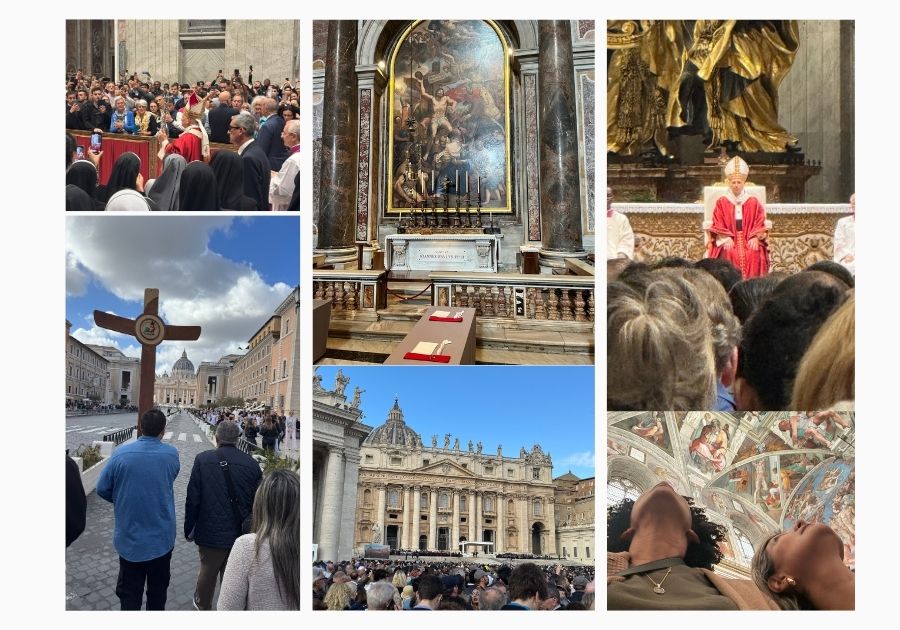
We gathered in St. Peter’s Square for the Papal Audience, part of the Jubilee celebration. Pilgrims from every corner of the world filled the plaza; nuns, families, students, and elders, all waiting beneath the same Roman sky.
When Pope Leo XIV appeared, the noise dissolved into awe. He spoke of mercy, humility, and hope — words that sounded simple until you felt how deeply they resonated. Looking around at the faces near me, with different languages and stories, I realized this is what living faith looks like. Imperfect, diverse, still showing up.
The next day carried its own rhythm of grace: quieter, heavier, holier.
In the late afternoon, we joined the pilgrimage of the wooden cross through the streets leading to St. Peter’s Basilica. The cross passed from hand to hand, each person carrying it just long enough to feel its weight, short enough to remember we were never meant to carry ours alone. Rome’s usual noise- scooters, chatter, footsteps- seemed to hush as we walked. It felt like the city itself was holding its breath.
Before entering the Basilica, I visited the Sistine Chapel. Standing beneath The Creation, I thought of that small gap between God’s and Adam’s fingers, the eternal reach that never stops seeking us.
Then came one of the most humbling moments: visiting the tomb of Saint John Paul II. There was no grandeur there, only stillness, a sacred quiet that felt alive. I prayed for the courage to live my faith as he did: steadfast, human, unafraid.
We also gathered for Holy Mass inside St. Peter’s Basilica, celebrated by the Pope. The choir began, incense rose toward the dome that had witnessed centuries of prayer. The Pope’s voice, gentle and steady, filled the space with a calm authority that needed no amplification. When he lifted the Host, thousands fell silent. It felt like heaven and earth exhaled together. It wasn’t spectacle; it was surrender. And I realized peace isn’t found in noise or certainty, but in stillness.
That day; carrying the cross, standing beneath Michelangelo’s sky, kneeling at St. Peter’s altar, and praying at John Paul II’s tomb, became the embodiment of Chill. Not chill as indifference, but chill as trust, the sacred calm that comes when you stop gripping and start breathing.
Maybe Jesus Is Coming Soon isn’t about waiting for an ending. Maybe it’s about recognizing His presence right now, in the crowd, in the silence, in every trembling act of faith that keeps us walking forward.
What Changed Inside
Pilgrimages don’t end when you fly home. They end when you begin to live differently. Somewhere between Kraków and Rome, between silence and song, I realized this journey had carried me through the three parts of my book, almost as if I had walked them in real time.
In Poland, I lived F*ck You All, not in defiance but in freedom. I stopped apologizing for needing space, for feeling deeply. Walking through the weight of history, I learned that boundaries aren’t walls; they’re sacred doors protecting what’s holy inside you.
In Rome, I lived Chill, that holy calm that comes from trusting God more than control. That peace doesn’t come from knowing what’s next, but from knowing I’m held.
And through it all, I met Jesus Is Coming Soon, not as prophecy but as promise, as if He’s always arriving quietly every time we soften, forgive, or breathe again.
I came looking for miracles, and instead, I found mercy. I came to see the tombs of saints and instead met the living God, still speaking in the silence. This pilgrimage reminded me that faith isn’t performance; it’s presence.
And peace doesn’t come from control; it comes from surrender.
So yes, F*ck You All, Chill, and Jesus Is Coming Soon, not as slogans, but as a map.
A map for staying grounded when the world spins, gentle when the cross feels heavy, and awake when love calls again.
In liberation and in peace,
Luz